What is LED display and how to choose the right size

- Admin
- Comment 3
-
What is an LED screen and what does it consist of?
An LED screen is a flat panel display that uses a horizontal and vertical matrix array of light-emitting diodes as pixels to display video. Its high brightness makes it possible to display images with high visibility in outdoor spaces, even in direct sunlight.
As we all know, an LED screen is essentially built from small units called LED modules, which are combined to form LED screen cabinets. The cabinets are then connected to form a complete screen. -
What content do you plan to display?
If you need to display dynamic videos without flickering when captured by a camera, then a high refresh rate (60+ Hz), high brightness and resolution (pixel density) are more of a priority. We will discuss these issues in more detail below. -
Where is your LED display being used. Indoor or outdoor?
If it is indoors, the brightness and protection level of the LED panel do not need to be as high as the requirements for outdoor LED displays.
For an indoor event, ~3000 lumens are sufficient.
For outdoor use, 3000-5000 lumens are recommended, depending on whether the screen is exposed to direct sunlight. Also, an outdoor screen should meet the IP65 standard, which will protect it from rain, snow, and dust (you can read more about this standard here). -
What pixel pitch do you need?
Pitch is measured by the horizontal (and vertical) spacing between pixels.
Nomenclature: P#, where # denotes millimeters between pixels. For example:
P2: 2mm (or 1.953mm) spacing between pixels. 1 sq.m. The area consists of 512x512 = 262,144 pixels.
P2.6: 2.6mm (2.604 mm) spacing between pixels. 1 sq.m. The area consists of 384x384 = 147,456 pixels.
P3: 3mm (2.976 mm) spacing between pixels. 1 sq.m. The area consists of 336x336 = 112,896 pixels.
P4: 4mm (3.91 mm) spacing between pixels. 1 sq.m. The area consists of 256x256 = 65,536 pixels.
P5: 5mm (4.81 mm) spacing between pixels. 1 sq.m. The area consists of 208x208 = 43,264 pixels.
....
P10 ...
The exact spacing is not a round number (e.g. 2m -> 1.953m) because for 0.5x0.5m and 0.5x1m cabinets (standard in the rental industry) the pixel counts are calculated in binary multiples, or powers of two. For example, 1.953mm fits exactly 512 times in 1 meter (2^9 = 512), etc.
The closer the pixels are on the screen, the higher the cost of both its production and rental.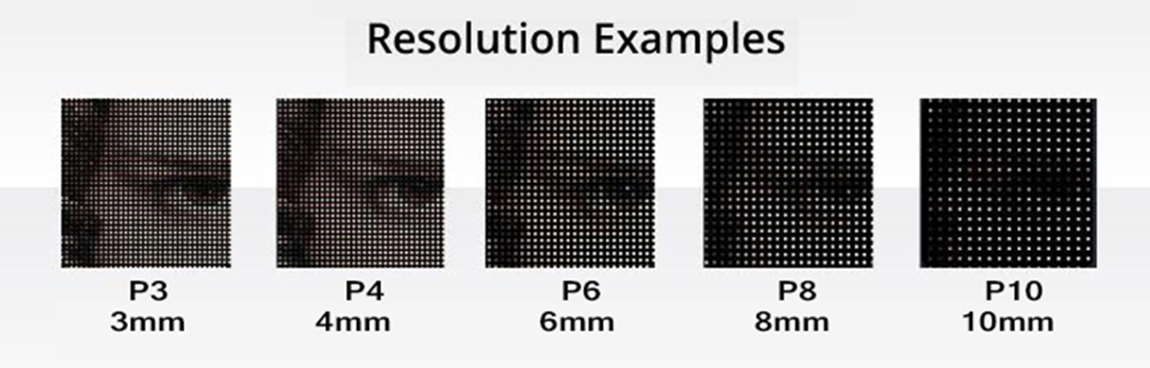
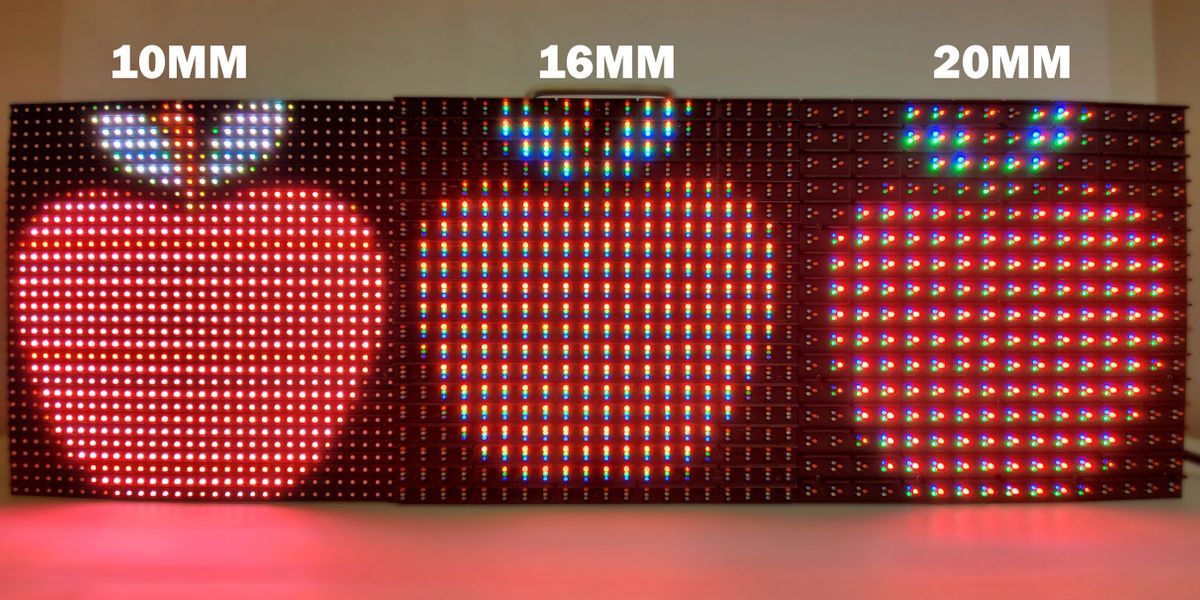
You can use the following infographics to calculate the quality and most cost-effective pixel density for you.
-
What size screen do you need?
There is a so-called rule-of-thumb formula for selecting the size of the screen:
We take the farthest point of the audience F. The screen height should be approximately in the range of F/6 - F/8. For example: if the maximum distance is 30 meters, the screen height should be in the range of 30/6 - 30/8, or between 5 - 3.75 meters.
Aspect ratio:
Width:Height
16:9 / 4x3 / 5x3 is the most popular ratio used for video-intensive images, although wider ratios of 1.85:1 - 2.4:1 (interval) may also be used for cinema screenings.
For text presentations, it is preferable to have a relatively tall screen: for example, a square one.
In any case, modern video processors (Novastar VX400, TB50) have a so-called scaling function, which means that the image can be stretched to any dimension in the vertical or horizontal direction.